

Fourth Sunday after Pentecost sermon, faith of the centurion, Jesus heals the centurion’s servant, Matthew 8:5–13 explained, Luke 7 centurion meaning, Christian sermons on faith, healing by the word of Christ, what amazed Jesus in the Bible, inclusive nature of the Kingdom of God, Gentile faith in the Gospels
Fourth Sunday after Pentecost: The Healing of the Centurion’s Servant
After delivering the “Sermon on the Mount,” Christ set out toward Capernaum, the place where He had taken up residence. The Gospel tells us that “great multitudes followed Him” (Matt. 8:1). All who had been touched by Christ’s words followed Him. They wanted to be where He was. That is what it means to be a Christian – a follower of Christ. It is not enough to occasionally go to church, listen to the Gospel and a sermon. A Christian strives for daily communion with Christ. A Christian simply cannot live without Christ. He does not depart from Him but has a continual need to follow Him.
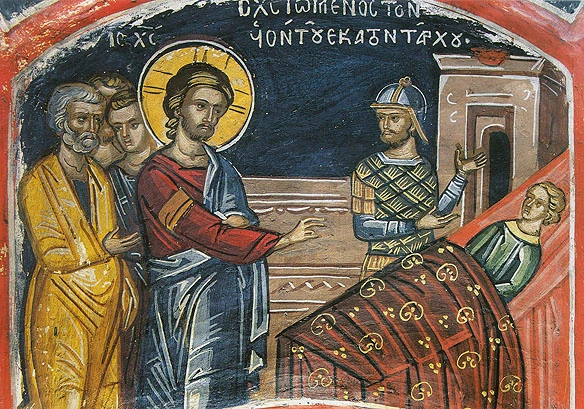
When Christ entered His city, a Roman centurion, a pagan, approached Him and asked that Christ come and heal his servant. The centurion was a lower-ranking officer of the Roman units, commanding about 100 soldiers. The Greek word for centurion used in today’s Gospel is hekatontarchos, which means “commander of a hundred,” or centurion (from the Latin centurio).
In Luke 7:1–10, this event is described somewhat differently than in the Gospel of Matthew. There we read that the centurion sent “Jewish elders” to meet Christ. Some may say that these two accounts of the same event contradict each other. However, the differences found in the two Gospels are actually complementary, as Saint Bishop Nikolaj Velimirović explains: “Indeed, there are differences in these two accounts, but no contradictions. The difference lies in this: Matthew omits and does not mention the two delegations that the centurion previously sent before the Lord, while Luke omits and does not mention that in the end, the centurion himself, despite all his humility and awe before Christ’s majesty, came out to meet Him. This wonderful complementarity between the Evangelists evokes in the spiritual person only joy and wonder.”
What we learn in Luke’s Gospel is that the centurion loved the Jewish people and had built a synagogue for them. That is why the “Jewish elders” considered him worthy of receiving what he asked from Christ (Luke 7:4–5). These details are important to help us understand the centurion’s character. Although he was an officer of the occupying army and a pagan, he was a good man, a man of great heart. Though he held authority not only over his soldiers but also represented power over all the Jews, he served the Jewish people through his love.
The centurion also shows his goodness by pleading with Christ for his servant. The servant was severely ill, “grievously tormented,” meaning he was in great pain and likely on the verge of death. The Evangelist Luke tells us that the servant was “dear” to the centurion. This centurion did not view his servant’s life as expendable or as a commodity that could simply be replaced by purchasing another slave at the market. For him, even the life of a servant was valuable, which also tells us he acted responsibly toward his soldiers as their commander.
Christ responds to him: “I will come and heal him.” That is how we read it in our translation. However, in the original text, according to some New Testament scholars, Christ’s statement sounds more interrogative than affirmative. In fact, Christ says: “Shall I come and heal him?” This question makes sense when we understand that Jews did not enter the homes of pagans. Christ, as in many other cases (e.g., His conversation with the Canaanite woman), refers to Jewish customs in order to test the centurion’s faith. The centurion is also aware of Jewish religious regulations and is ready to respect them, believing that Christ can heal his servant without even entering his home: “Lord, I am not worthy that You should come under my roof, but only speak a word, and my servant will be healed.” The centurion could have simply said that he knew the regulations, but instead he expresses humility and faith in Christ. He doesn’t say, “I know You’re not allowed to enter my house,” but rather, “I am not worthy.” As we mentioned earlier, the centurion was a representative of authority and thus had jurisdiction over all Jews, including Christ. He even affirms this himself: “For I also am a man under authority, having soldiers under me. And I say to this one, ‘Go,’ and he goes; and to another, ‘Come,’ and he comes; and to my servant, ‘Do this,’ and he does it.” However, the centurion now recognizes that he stands before the One who has authority over all things, including every disease. He acknowledges that Christ’s authority is far greater than his own, and in a certain way, he places himself under Christ’s authority.
The centurion considers himself unworthy before Christ. He sees himself as a sinner. He also believes that Christ, by His word alone, without entering his house, can perform the miracle of healing his servant. In this encounter, we see the true meeting of God and man – a man who is aware of his sinfulness and unworthiness, and God who has the power to heal with His word and to make us into new, whole people.
“When Jesus heard it, He marveled…” This is the only place in the New Testament where we read that someone amazed Christ. The centurion did not astonish Christ because of his position, reputation, or even for being a good man who built a synagogue. What amazed – rather, delighted – Christ was the centurion’s faith. Let us remember that “many people” had followed Christ after the Sermon on the Mount. Christ turns to them, as well as to the apostles, and says: “Truly I say unto you, I have not found such great faith, not even in Israel.” In other words, He says to them, “Do you see what faith is? This is faith worthy of admiration.”
The Jews looked upon pagans with disdain. They considered them unclean heathens. We can only imagine how it must have felt to those who believed themselves spiritually superior to all other peoples to hear Christ praising the faith of a heathen – and a Roman officer at that. The Lord uses this opportunity to speak about the true nature of His Kingdom. While the Jews expected an earthly kingdom that the Messiah would establish and in which they would dominate others, Christ tells them that the Lord will call many “from east and west” to “sit down with Abraham, Isaac, and Jacob in the Kingdom of Heaven.” Who are these “many”? If the “sons of the Kingdom” Christ refers to in the next verse are those to whom the Kingdom rightfully belongs – that is, the chosen people of Israel – then the “many” are those whom the Lord will call from various nations and languages to sit “at the table with Abraham, Isaac, and Jacob.” For a Jew to sit at a table with a pagan would render him ceremonially unclean. Yet Christ names the spiritual patriarchs of God’s chosen people sitting at the same table with those coming from pagan nations. At the same time, Christ declares that belonging to the chosen people is no guarantee of entering the Kingdom of Heaven. Many of them will be “cast out into outer darkness; there will be weeping and gnashing of teeth.”
Christ opens the doors of the Kingdom of God to all who believe in Him. From the entire dialogue between Christ and the centurion, the centurion’s faith in Christ is evident. He had surely heard of Christ’s words and deeds before. He was probably aware that the Jewish people were expecting a Messiah. Perhaps he even knew some of the Old Testament prophecies about the character of the coming Redeemer. What the “sons of the Kingdom” failed to recognize in Christ, this pagan, Roman centurion recognized. That is why Christ praises his faith and says to him, “Go your way; and as you have believed, so let it be done for you.” In the end, faith gives meaning to everything. Scripture tells us that faith is “the substance of things hoped for, the evidence of things not seen” (Heb. 11:1). Saint John of Damascus interprets this by saying that faith is “the unwavering and decisive hope in the fulfillment of what God has promised and what we have asked of Him.” The centurion did not merely believe in Christ – the centurion believed Christ. The healing occurred the moment Christ said, “As you have believed, so let it be done for you.” This confirms the fact that the centurion truly believed that the miracle of healing his servant would happen. He believed Christ “at His word.”
May God help us to believe even when it is difficult to believe. Let us also say to Christ, “Only speak the word,” believing that He Himself is the Logos – the creative Word by whom all things were made, by whom we were brought “from non-being into being,” and by whom we are brought into wholeness – healed for His glory. Amen.
Author: Jasmin Milić, PhD
 ИПОСТАС - Хришћанско удружење